
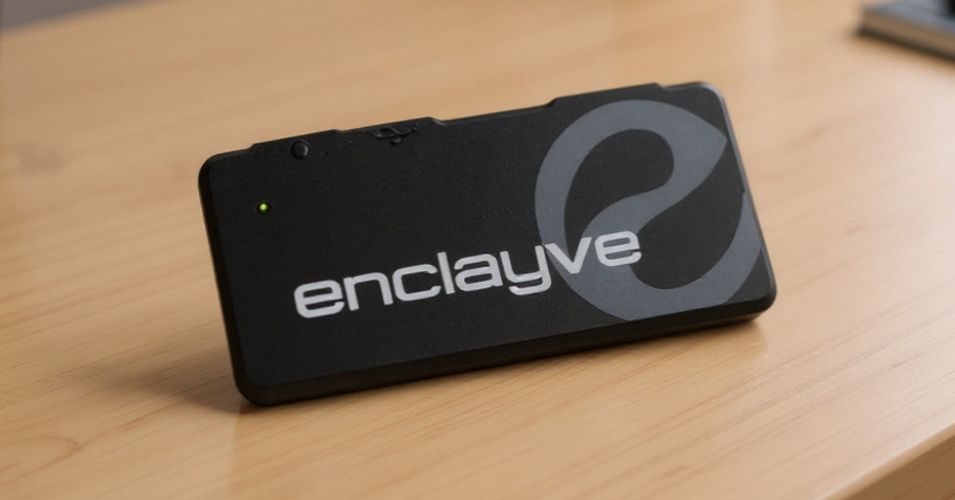
Enclayve is a private social service hosted on a physical device. Plug it in, connect to Wi-Fi, and the device acts like a central server for a social network that can accommodate up to a few hundred people. Only the person with the device and the people they invite can log in and see what is shared there.
The device is a little rectangular plastic box, smaller than a credit card. It costs $129, but only one person needs to own it, and they can invite others in. (They’ll also have to download the app.) Once allowed in, the app looks like a bare-bones social media site. People can post in groups to chat and share photos. All messages and media sent between people in a group are stored on the device, which comes with a 32-GB microSD card that can be swapped out as needed. There is no subscription cost, no ads, no in-app purchases, and no data tracking by Enclayve, the company says.
Enclayve is meant to be a rebuttal to social sites like Facebook and X. Instead of having to post everything publicly and tacitly allow a company to suck up all data about your interactions on its platform, Enclayve stores all that information on a physical device and encrypts everything. It is the latest in a lineage of privacy-focused devices that aim to help users control their own data, like security cameras that keep footage local or hardware firewalls that protect you online.

Courtesy of Enclayve
David Chura, CEO of Enclayve, is a former director at Northrop Grumman and father of two. He says he was inspired to build the product in 2020 after watching Meta CEO Mark Zuckerberg make some unconvincing privacy promises in testimony to US Congress.
“They were so underpowered it made me believe that there’s never going to be legislation that can actually address issues in social media,” Chura says. “Consumers need to be able to protect themselves.”
Chura says that while Enclayve’s focus is a private social media service, there were initially three distinct versions of the device: one designed to be a wallet for cryptocurrency and another for NFTs, or nonfungible tokens. As the crypto economy collapsed and the idea of paying real money for digital “art” lost popularity, those deals fell through, and Enclayve became marketed solely as a social device.
Enclayve launched in March. The company positions its product like a group app for families like Family Album. Enclayve wants to take that a step further and keep everything everyone sends on its platform safe in its physical box. Device owners can create separate groups and topics and choose who gets invited to what. It feels like a stripped-down version of WhatsApp’s Communities feature, or even a very simple Slack workspace.



No Comment! Be the first one.