

This article was updated to remove references to Walt and its planned rebrand after the related announcement did not go live as expected.
GRAM has rebounded toward $1.40 after Telegram began releasing its self-custodial Gram Wallet to selected users, while trading volume rose about 137% around the announcement.
Summary
- GRAM gained about 2% over 24 hours after briefly approaching $1.46.
- Telegram plans to release Gram Wallet gradually to its billion-plus users.
- The wallet will support self-custody, fee-free transfers, and Telegram Collectibles.
- GRAM faces immediate resistance near $1.39, followed by $1.45.
Telegram begins phased Gram Wallet release
Telegram CEO Pavel Durov said the company had started giving selected users access to Gram Wallet before expanding availability across the messaging platform over the coming weeks.
“We’ll be gradually rolling it out to our billion+ users over the next couple of weeks,” Durov said in a Telegram post.
Built directly into the messaging app, Gram Wallet will become the default wallet displayed in Telegram’s user settings. The product uses a self-custodial structure, allowing users to control their crypto assets instead of leaving custody with a centralized provider.
Telegram plans to support instant, zero-fee transactions through the wallet, according to Durov. Users will be able to send funds, make payments, and complete purchases inside the app. Gram Wallet will also support Telegram Collectibles, a category that includes digital gifts, usernames, and phone numbers.
The release follows an announcement in July, when Durov said Telegram would add a native, non-custodial wallet to every version of its app. As crypto.news reported at the time, Telegram had not disclosed its planned recovery system, security safeguards, identity requirements, or regional restrictions.
Telegram reported more than 1 billion monthly active users in 2025. Durov has not provided an adoption target for Gram Wallet or disclosed how many accounts received access during the first phase.
Validators approve the wallet’s smart contract
According to Durov, network validators approved the smart contract supporting Gram Wallet before the phased release started.
The contract’s design will allow developers to upgrade the wallet without requiring users to transfer their holdings into a replacement contract, Durov said. Such migrations can create extra steps for users and open opportunities for fraudulent links or fake upgrade requests.
Telegram has presented the product as a simpler route to self-custody for users who may not have previously managed crypto through an independent wallet. Self-custody means the user controls access to the assets, but it also places responsibility for account security and recovery on the holder.
The company has not yet published complete technical documents explaining how users will recover access if they lose a device or forget their credentials. Telegram has also not said whether the advertised zero-fee transfers apply to every type of transaction or only to transfers completed within the product.
Plans announced in July described Gram Wallet as a payment tool tied closely to Telegram’s existing services. The current release adds a distribution timeline, with access expected to spread across the platform during the next couple of weeks rather than reaching all users at once.
Toncoin became GRAM after an 81% vote
The wallet release comes about two and a half months after Toncoin officially became Gram.
A community vote approved the change with 81.22% support, and the renamed asset took effect on June 15. The blockchain retained The Open Network name, while its native cryptocurrency changed from Toncoin and the TON ticker to Gram and GRAM.
A June guide to the rebrand explained that the change did not create a new token or require holders to complete a swap. Existing balances, wallet addresses, smart contracts and staking positions remained in place, with only the asset’s name, ticker and logo changing.
Users holding Toncoin, therefore, did not need to send funds, connect their wallets to a migration website or claim replacement tokens. Messages asking holders to perform such actions could expose them to impersonation or wallet-draining scams.
GRAM previously gained nearly 19% when Durov disclosed the proposed rename in early June. The token reached about $2.21 before surrendering part of the advance, according to earlier market coverage.
The Gram name originated in Telegram’s 2018 blockchain project, although the first planned token distribution faced enforcement action in the United States. The U.S. Securities and Exchange Commission sued Telegram in 2019, alleging that its $1.7 billion fundraising arrangement and planned distribution formed an unregistered securities offering.
A federal court later blocked the distribution, and Telegram settled the case in 2020. According to an SEC commissioner’s account, the settlement included $1.2 billion in disgorgement for returning money to purchasers. Telegram also agreed to pay an $18.5 million civil penalty.
Independent developers continued working on the open-source network after Telegram withdrew from the original project. The current GRAM asset is the renamed native token of the network that emerged from that development, rather than a new release of the tokens blocked in the 2020 case.
GRAM price tests resistance near $1.39
Market data showed GRAM trading near $1.40 at press time, up approximately 2.07% over 24 hours. The announcement initially carried the token close to $1.45 before sellers erased part of the increase, while trading volume climbed about 137%.
On the four-hour chart, the latest displayed candle opened at $1.338, reached $1.457, and fell as low as $1.332 before returning to approximately $1.385. The candle represented an increase of about 3.44%, although its long upper wick showed that sellers became active above $1.45.
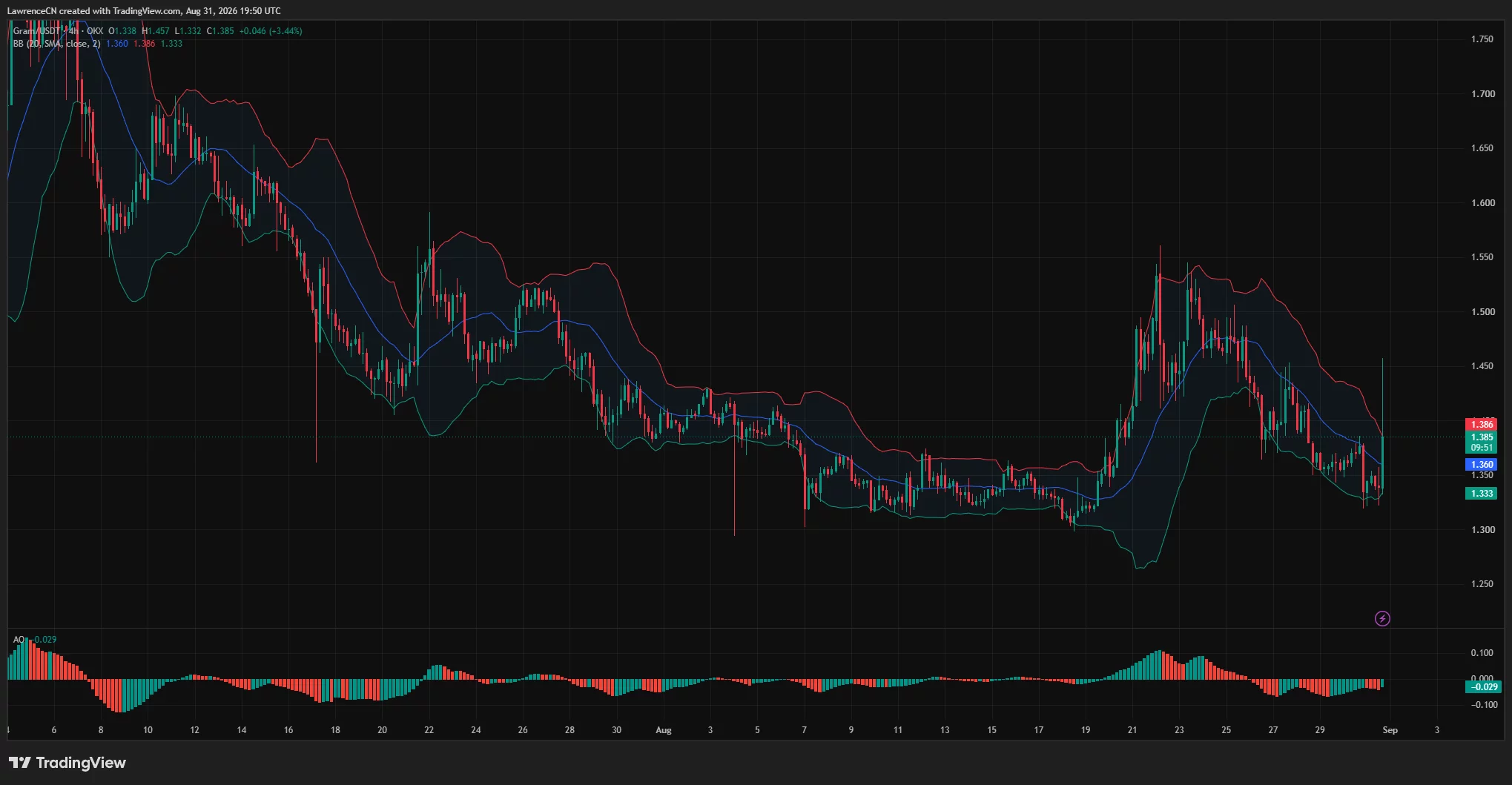
Bollinger Bands placed the 20-period midpoint near $1.360. GRAM moved above that level during the rebound and reached the upper band at approximately $1.386, leaving the $1.385–$1.40 area as the first resistance zone shown by the indicator.
A sustained move above $1.40 would expose the recent rejection area between $1.45 and $1.46. Sellers previously defended the same zone during the wallet-driven spike visible on the four-hour chart.
On the downside, the Bollinger midpoint near $1.360 provides the first visible support, followed by the lower band around $1.333. The Awesome Oscillator remained below zero at approximately minus 0.029, indicating that bearish momentum had not fully cleared despite the rebound in the latest candle.

Other Articles

CLARITY Act Odds Stay Buried as Senate Showdown Closes In
USDD 2.0 has no whitepaper, no governance, and 20% yield
No Comment! Be the first one.