
Key Takeaways
- What is Bitunix? An international cryptocurrency exchange offering spot markets, perpetual futures, and copy trading.
- Custody and Security: Bitunix identifies Fireblocks and Cobo as custody infrastructure providers, publishes Proof of Reserves information, and describes a $50 million USDC Care Fund.
- Trading Tools: Documented features include TradingView integration, customizable chart layouts, conditional orders, and configurable copy-trading controls.
- Fees and Accounts: The platform uses a tiered maker/taker fee schedule. Verification status, account conditions, and regional requirements affect access to services.
In the digital asset ecosystem, different trading venues cater to diverse market needs and trading strategies. While spot exchanges can serve as primary on-ramps for long-term asset accumulation, dedicated derivatives platforms are built around contract execution, high leverage, and automated risk orders.
Within the international derivatives space, platforms focus heavily on order-routing speed, multi-layered custody integration, and technical charting workspaces. One international platform operating in this segment is Bitunix.
This article is published in collaboration with Bitunix.
Introducing Bitunix

Founded in late 2021 and officially launching global operations in 2022, Bitunix is an international digital asset exchange specializing in spot and perpetual derivatives markets. The platform’s technical focus centers on providing high-throughput order execution, customizable charting interfaces, and a global liquidity profile.
Bitunix Overview
- Products: Spot trading, perpetual futures, and copy trading
- Published Leverage: Up to 200x on BTC/USDT and ETH/USDT perpetual futures, subject to position size and applicable limits
- Custody Stack: Fireblocks & Cobo
- Solvency: Published reserve ratios and Merkle-tree verification
- Additional Protection Fund: A $50 million USDC Care Fund, according to Bitunix
From an operational standpoint, Bitunix is an international commercial entity. The leverage limits, custody arrangements, and funding options above reflect Bitunix’s published documentation. Product availability varies by account and jurisdiction.
Security and Custody Architecture
Bitunix describes several components of its asset-protection framework, including custody infrastructure, external security assessments, reserve disclosures, and a protection fund.
- Institutional Multi-Party Computation (MPC): Bitunix says it uses infrastructure from Fireblocks and Cobo to support asset custody. The company also describes separating hot and cold wallets and using multiple approval controls for transactions.
- Fireblocks uses Multi-Party Computation, or MPC, technology. In this arrangement, distributed cryptographic key shares participate in signing transactions without reconstructing a complete private key in one location.
- Cold Storage Management: Approximately 98% of platform assets are kept in multi-signature cold storage environments, with roughly 2% maintained in online hot wallets to ensure daily withdrawal liquidity.
- Third-Party Security Audits: The platform’s application layers and smart contract logic have undergone penetration testing and audits by independent cybersecurity firms Hacken and Salus.
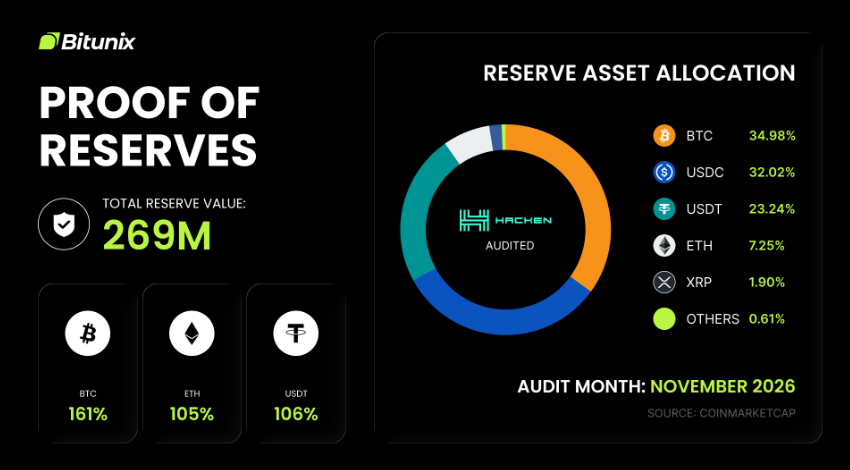
- Proof of Reserves (PoR): Bitunix implements an on-chain 1:1 Proof of Reserves mechanism. Utilizing cryptographic Merkle trees, users can independently verify that their account balances are accounted for within the platform’s state root snapshots.
- $50M User Protection Fund (“Care Fund”): Bitunix maintains a dedicated $50 million emergency risk pool. A key distinction of the Care Fund is its collateralization in USDC (a dollar-pegged stablecoin), avoiding the volatility risks of backing emergency funds with native platform exchange tokens.
Core Trading Features and Engine Mechanics
Bitunix’s trading interface is engineered primarily for active market participants who require technical charting and programmatic order execution:
Advanced Order Workflow
- Market & Limit Order Types
- Stop-Limit & Stop-Market Triggers
- Trailing Stops (Dynamic Momentum Tracking)
- One-Cancels-the-Other (OCO) Bracket Orders
1. Matching Engine & Workspace Customization
Bitunix advertises millisecond-level order matching. This describes the company’s stated matching performance and should not be interpreted as a guarantee of end-to-end execution speed under every market condition.
The platform describes TradingView integration alongside its Ultra charting interface. Its web terminal supports up to 16 chart windows using 35 layout presets, with options to display different pairs, timeframes, and indicators. Synchronization controls can link symbols, intervals, crosshairs, and date ranges across windows.
2. Conditional Order Management
Traders have access to basic to advanced order types designed to execute automated risk parameters:
| Order Type | Function |
| Market | Seeks execution at available market prices. |
| Limit | Sets a specified buying or selling price; the order may remain unfilled. |
| Trigger | Submits a market or limit order after a preset price condition is met. |
| Trailing | Tracks price movement after activation and triggers an order when the configured retracement condition is reached. |
These order types provide different ways to specify execution conditions. The selected order type affects how an instruction is activated and whether it prioritizes price or immediate execution.
Trailing Orders: Bitunix’s trailing-order guide describes a configurable activation price and retracement range. The feature can be used for both entry and exit strategies, including orders that respond to a rebound from a low or a reversal from a high.
One-Cancels-the-Other: Bitunix also describes OCO functionality linking take-profit and stop-loss orders. Execution of one linked order cancels the other, reducing the need to cancel the remaining instruction manually.
3. Perpetual Futures Mechanics
Bitunix offers USDT-margined perpetual futures and has introduced USDC-margined contracts. Its documentation lists leverage of up to 200x for BTC/USDT and ETH/USDT perpetual futures, subject to position size and applicable risk limits. Maximum leverage differs across contracts.
Mark Price and Liquidation: Bitunix distinguishes the last traded price, index price, and mark price. The index price provides a reference based on prices across multiple exchanges, while the mark price is used for unrealized profit and loss and liquidation calculations. This approach is intended to reduce the influence of abnormal individual market prints on position-risk calculations.
Position Limits: Bitunix documents a tiered risk framework linking position size, maximum leverage, and maintenance-margin requirements. Its liquidation procedures may involve canceling orders or reducing positions before full liquidation, depending on the position’s risk tier and margin condition.
4. Copy Trading Module
Bitunix’s copy-trading interface allows accounts to follow lead traders with configurable settings. The published controls include:
- Isolated Margin Mode: Copiers can restrict trade mirroring strictly to isolated margin, protecting the remainder of their portfolio from being drawn into open positions.
- Slippage Tolerances: Users can configure maximum acceptable slippage thresholds, automatically declining trade execution if the entry price diverges too far from the lead trader’s fill price.
Fee Economics and Account Tiers – Trading Fee Schedule
Bitunix operates on a competitive volume-tiered maker/taker schedule:
| Account Tier | Spot Maker | Spot Taker | Futures Maker | Futures Taker |
| VIP 0 | 0.0800% | 0.1000% | 0.0200% | 0.0600% |
| VIP 1 | 0.0700% | 0.0900% | 0.0200% | 0.0500% |
| VIP 3 | 0.0350% | 0.0600% | 0.0140% | 0.0400% |
| VIP 5 | 0.0150% | 0.0450% | 0.0100% | 0.0350% |
The published schedule lists alternative qualification criteria involving 30-day spot trading volume, 30-day futures trading volume, or account balance. These are separate measures, rather than one combined trading-volume threshold. Rates and qualification requirements may change.
Perpetual futures also involve funding payments. Depending on the funding rate and position direction, an account may pay or receive funding at scheduled intervals. These payments are separate from trading fees. Cryptocurrency withdrawal charges also vary by asset and network.
Account Verification & On-Chain Rail Support
Bitunix uses tiered Know-Your-Customer verification. Its guidance updated October 16, 2026 states:
| Verification Level | Published Requirements and Access |
| Unverified | Basic account functions, with restrictions on certain services |
| Level 1 | Government-issued identification and a biometric selfie check; unlocks cryptocurrency withdrawals |
| Level 2 | Proof of address; provides higher published withdrawal limits and additional eligible features |
Actual service access and limits depend on regional requirements, verification status, and account risk assessment.
Cryptocurrency Transfers and Fiat Purchasing Channels
Bitunix supports cryptocurrency deposits and withdrawals through supported asset-and-network combinations. Its published USDT withdrawal options include Tron, Ethereum, Arbitrum, Optimism, Solana, and BNB Smart Chain. Network availability is specific to the asset and transfer service involved.
The platform also documents fiat purchasing channels, including euro deposits through SEPA and credit or debit card purchases. Availability depends on location and eligibility; these global options do not establish direct support for Philippine bank transfers or local e-wallets.
Risk and Considerations
When evaluating international trading venues, users should balance platform utility with personal risk management and regulatory context:
- Utilizing leverage can significantly magnify trading outcomes in both directions. Traders should configure strict stop-loss parameters and avoid over-leveraging volatile assets.
- Centralized exchanges hold private keys on behalf of users. Best operational practices dictate keeping only capital designated for active trading on the platform, while transferring long-term portfolio reserves to self-hosted hardware wallets (Not your keys, not your coins).
This feature review is published on BitPinas: How Bitunix Works: A Platform Guide to Features, Custody Architecture, and Risk Controls
What else is happening in Crypto Philippines and beyond:

Other Articles

Czechia vs. Spain 2026 livestream: How to watch Nations League for free
Important Cardano News and ADA Price Update: November 12

No Comment! Be the first one.