
Key Takeaways
- Moonpay launched an AI payment vault on July 29, 2026, connecting to the artificial intelligence (AI) models Claude and ChatGPT.
- Sodot’s infrastructure secures $50 billion in assets across the vault’s Moonpay backend.
- Moonpay plans to add DeFi swaps and perpetual futures trading for AI agents next.
The Moonpay new product, called PayBox, connects to Claude or ChatGPT through a custom connector. A user types a request in plain language, such as moving $100 into PYUSD or swapping tokens for SOL. The AI prepares the transaction. A human approves it with a passkey. The money moves only after that approval.
Built Around a Passkey, Not a Handoff
Before this launch, an AI assistant could answer questions and automate work, but moving money meant handing the task to a terminal, a developer tool, or a third-party custodian. Moonpay’s vault removes that handoff. On Wednesday, in a note sent to Bitcoin.com News, the company explained that no single party, including Moonpay or the AI agent itself, can access a user’s full private key or sign a transaction alone.
Wallet keys are split using multiparty computation and held inside secure hardware enclaves. Payment cards are stored so an agent can charge them without ever seeing the card number, using Visa’s agentic commerce protocol.
Two Ways to Set Permissions
Users choose one of two models for their AI agent:
- Always Ask, where every transaction needs a passkey approval.
- Autonomous, where the AI can act on its own within limits the user sets in advance.
Changing those permissions always requires a fresh passkey approval from the human user. Every authorization is scoped to a single action and cannot be reused, and access can be revoked at any time.
Closing Three Fraud Vectors
Moonpay says agentic payment fraud typically comes from a stolen credential, a leaked card number, or a single system that can move funds once it is compromised. The vault targets each one directly. Split wallet keys mean a compromised phone does not hand an attacker the ability to move funds, since no device holds a complete key. Visa’s protocol keeps raw card numbers out of the transaction entirely. Single-use passkey approvals mean a captured authorization cannot be replayed or expanded into broader access.
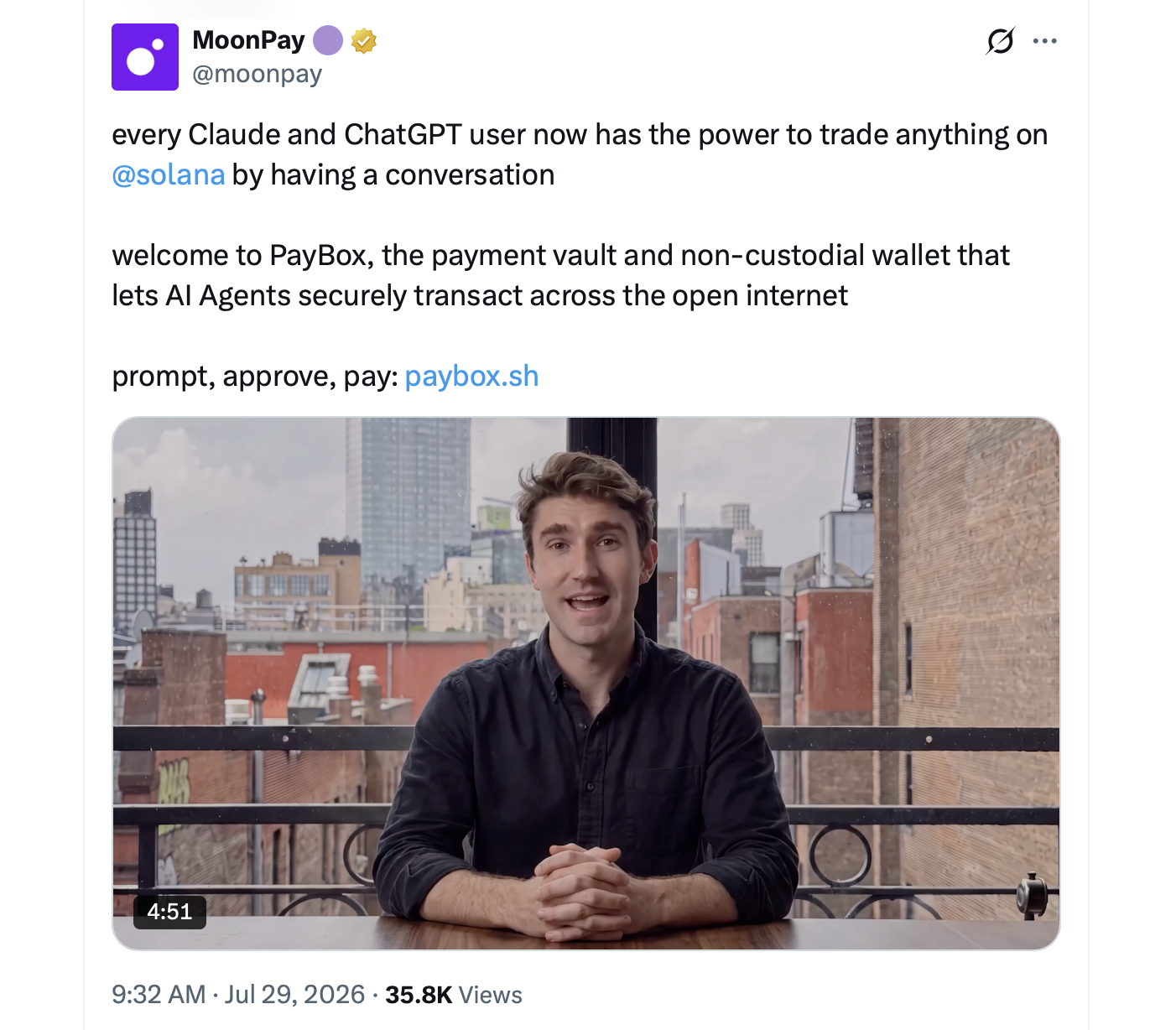
“The card hid the cash. The phone hid the card. This is the era where money disappears into conversation. Billions of AI agents are coming online, and every one of them will need to hold, move, and spend money safely. Someone had to build the trust layer for that world. We just did,” Ivan Soto-Wright, chief executive and founder of Moonpay, remarked in the announcement shared with our newsdesk.
Backed by a $50 Billion Security Stack
The vault runs on infrastructure from Sodot, a key management firm Moonpay acquired earlier this year. Sodot secures more than $50 billion in assets and over 10 million wallets for crypto companies. Moonpay pairs that infrastructure with its base of more than 1,700 enterprise clients.
Live on Seven Chains
The vault supports Solana and EVM-compatible networks, including Ethereum, Base, Arbitrum, Polygon, Hyperliquid, Tempo and Robinhood Chain, with more planned. Payments route through x402, an open standard for agent-initiated transactions, letting the AI pay any service built to accept them. Restaurant reservations, travel bookings, and shopping with major online retailers are live now, with more integrations rolling out weekly.
What Traders Should Watch Next
Moonpay further disclosed that support for additional AI platforms is coming, along with deeper access to decentralized finance (DeFi). That includes letting AI agents route token swaps, trade perpetual futures and manage liquidity positions, all under the same user-set approval rules. For traders already using Claude or ChatGPT for research, the update turns those conversations into a direct line to onchain execution, without giving up control of the wallet.

Other Articles

When crypto tax stops being a spreadsheet problem

No Comment! Be the first one.